Engineering / 13 Oct 2026
Modelling the apparent motion of the Sun and its application to a small-scale dual-axis solar tracker
RESEARCH QUESTION
To what extent does dual-axis tracking increase the daily clear-sky insolation on a small panel in Tokyo compared with fixed and single-axis orientations, and can the Keyestudio KS0530 kit physically and energetically realise it?
Abstract
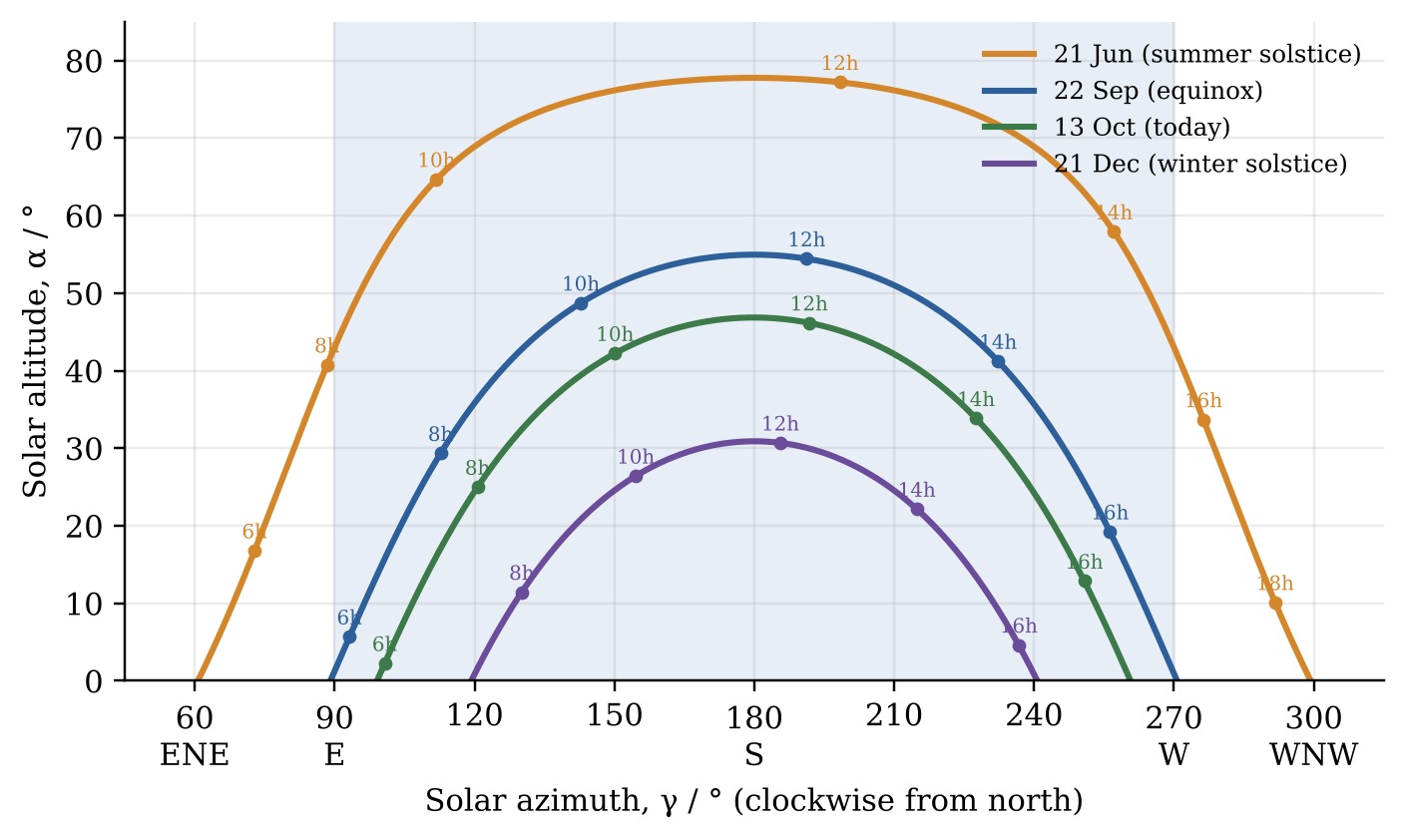
This report builds a sun-position and irradiance model for Tokyo to understand the motion a tracker has to follow, then maps that motion onto the hardware of the Keyestudio KS0530 solar tracking kit. Using the NOAA/Spencer solar-position equations with a Meinel clear-sky beam model, a dual-axis tracker was found to collect 8.33 kWh m⁻² on 13 October, 69% more than the kit's default flat position and 28% more than a fixed panel tilted 35° to the south. The analysis also shows two limitations of the kit. The 180° pan servo cannot follow the summer sun, which rises at an azimuth of 61°, so 40% of the available dual-axis energy on 21 June lies outside its range. More significantly, the electronics draw roughly 0.6 W, more than the panel's ceiling of about 0.4 W, so the kit is an excellent model of tracking motion but cannot be energy-positive at this scale.
Findings & limitations
Dual-axis tracking beats a fixed 35° south panel by 27.7% (13 Oct), 32.0% (equinox), 26.3% (December) and 60.7% (June).
A horizontal north–south single-axis tracker collects 16% less than a fixed tilted panel in December at Tokyo's latitude.
39.7% of 21 June dual-axis energy is out of the 180° pan servo's reach; an over-the-top “flip” mode recovers it without new hardware.
At kit scale the electronics use about five times the energy tracking gains; at a 4 kW home scale the same controller is ~0.015% of output.
Validation: solar noon matched published Tokyo data exactly; day length within 1.4%.
These are modelled clear-sky results. Physical hardware validation is planned.
Scientific background
Framed around the ScienceDirect topic overview on solar tracking systems and scaled down to a hobby kit. The report models the Sun at one-minute resolution with the Spencer and NOAA equations and a Meinel clear-sky beam model.
Publication details
Engineering project design research report (unpublished) · 13 Oct 2026 · Individual work
See the original report for full methods, references, and author details.